Wednesday, January 29, 2014

2013 Recap!

Life in "island time" can sometimes move a little slowly and as a Peace Corps Volunteer it is sometimes hard to see how all the little things we do add up. So here's a look back at 2013's highlights to help me gain some perspective.

From the work-related category:
  • The Bua Yaubula Management and Support Team (BYMST), a newly formed provincial environmental management network, had a series of planning workshops to help build their capacity to support sustainable resource management in Bua. They also submitted a grant proposal in hopes to be able to implement their mission. The district representative is a man from our village.
  • The village women  took full reins of their vegetable gardening project we started, and also built a chicken coop with support of the Ministry of Agriculture. They are now selling eggs and hope to expand their business.
  • As a result of attending district-wide natural resource management planning workshops, members of the village took the initiative to form a village Yaubula, or environment, Committee. We working to build their capacity and confidence to successfully continue projects when I leave. They have been raising awareness about environmental issues in our village meetings and working with our traditional leaders to set up some local protected areas.
  • We continued to plant mangroves and restock the nursery.
  • We stocked a few giant clams and sea cucumbers in our tabu fishing area. We submitted requests to receive some breeding stock from the Department of Fisheries.
  • We continued to try and get the support of Department of Forestry to train village members in setting up tree nurseries, especially focusing on sandalwood as an income generating species. (No luck yet!)
  • A request for Good Leadership and Governance Training for traditional leaders and committee members was submitted to the Ministry of iTaukei Affairs and it looks like it might come through soon!
  • We were able to report and stop some illegal sand extraction happening at the local beach. The sand was being used for the new Labasa-Nabouwalu highway.
  • The team at Wildlife Conservation Society (WCS) allowed me to team up with them for my Master's research. We will be doing social network analysis (SNA) as a way to better understand and hopefully improve collaboration and communication around natural resource management in our province. 
  • Department of Fisheries came and set up two oyster spat collection lines in our Tabu Area. These lines will be left for one year to collect and grow baby oysters to sell to pearl farmers.
  • We submitted a request for an extension of the electricity grid to our village and they came to survey. We have not yet received the quotation for the 5% we will have to contribute.
  •  Water Authority Fiji helped build a new dam and water storage tank for the village's drinking water. It's experiencing a few glitches, but we're hoping to work them out soon.
I'm thankful for all the support from the community members and our stakeholder friends in helping make all these little and big things happen.

From the personal side of things:
  • I extended my service for a 3rd year.
  • I started giving my report at village meetings in Fijian. (Preparing it ahead of time, of course!)
  • Two of my very best girlfriends visited and we had such a lovely time!
  • I survived being assaulted on a run in Suva! 
  • I ran my second half marathon and improved my time!
  • I learned how to stove-top bake, make jam, and "brew" hooch. 
  • I spent a month in the US and realized I miss my friends and family, but am so happy here in Fiji. 
  • And the best thing of all: Solo and I decided to get married! 


Monday, December 16, 2013

When Worlds Collide, Embrace Them Both


It’s a week before Christmas and hotter than Hades in the village. It’s the time of year when everything comes to a standstill as folks are preparing for the holidays, cleaning houses and yards, and pounding enough grog to last a month.  Instead of being frustrated with the slow pace, I’m trying to embrace it; take time to reflect on the past year and return to doing the little things I love about living in the village. 

Solo was admonishing me for planting some mangrove seeds by myself the other day in the hot, hot sun. “Can’t you just stay at home and relax for once? It’s a week until Christmas! It is not the time to work. Read a bunch of books.” 

So here I am sitting in my kitchen/office with a fresh batch of roasted cacao beans cooling on the counter courtesy of the pods we picked yesterday when we went to swim in the creek, and I’m slowly picking apart my current thoughts on village life. 

Sometimes I get frustrated with it, even after over two years of acclimating. Sometimes I wish we could do more, or that things would move along more quickly. But it is useless to get frustrated, it’s wasted energy, and it’s better to just accept the pace of village life. It seems I periodically re-learn the lesson that there is beauty in slowing life down, in caring more about family and friends than work, in making food from scratch, in doing small things that make you happy, in taking time to notice how elegantly a banana leaf unfurls itself from the stalk and how the vivid passionfruit flower opens in the evening. 

I’ve been thinking a lot about how American and Fijian cultures compare and contrast, and also about the current state of traditional Fijian culture. In the words of a friend, the culture seems “confused”. How do you keep traditions alive but develop at the same time?

The other week Solo brought over a book, Bula Vakavanua by Semi B. Seruvakula. It is written in Fijian. As much as I can understand, it was an effort by the Ministry of iTaukei (Indigenous) Affairs and the University of the South Pacific, amongst others, to document Fijian traditions as they have begun to slowly be lost. This book is a gold mine for someone who wants to learn about Fijian culture. Solo nabbed it from one of the school kids. As he never took Fijian in school, and since he spent most of his life outside the village, he’s just now being properly educated in the “ways of the village”. While we might not be able to stop things from changing, the least we can do is remember where we’ve come from. 

We’ve been going through parts of the book together. It explains everything about the ways of the vanua, or the responsibilities of the different people and clans in the village, how to conduct ceremonies of all levels, and how the land/sea is to be regarded. It also talks about the changes Fijian culture has faced and is still facing since the time of colonization. Fijians are great story tellers, and I love hearing Solo’s explanations and asking questions about it all. 

Solo: Isa, it’s not like this anymore.
Buna: Why?
S: Where is your wallet?
B: What?... In my room.
S: (Returning with my wallet, pulls out two bills.) This is why it’s not like that anymore. (Points at the Queen on the old bill.) This changed everything. But it’s starting to change again, we’re taking Fiji back. (Points at the new bill where the Queen has been replaced with some endemic Fijian wildlife species.)

This simple explanation makes me smile. I ask about the church, because didn’t that change a lot of things too? What did Fijians believe before the church?

S: There were only two churches, Catholic and Methodist in the beginning.
B: No before that.
S: Huh?
B: Before the churches came, did people believe in the vanua or what?
S: Yes, they believed in the landlords. But everyone was warring, warring all the time. Eating each other. When they won a war, they won the land and their landlord stayed there.
B: Landlord?..... You mean like a spirit?
S: Yeah, I mean like a land spirit.
B: Like the vu?
S: (Very hushed) Yes…

He then told me quietly about the vu of our village, his name, where he lives, and how he looks after the village. How he comes to speak thru people at certain times when the village is not working well together. How he did this just last year. He said all this very quietly and I knew it was kind of a sacred topic. There are certain things us outsiders aren’t supposed to talk about or question, so I just listened, appreciating what he was willing to share. I think traditional knowledge is a beautiful and interesting thing. But it is not my place to share it here; it is a story that is not mine.

However, in my story I do find myself amidst the convergence of the traditional and the modern. This is the setting in which I live and work. I sit here typing on my laptop in my house with no electricity. Sometimes it is a very confused place indeed; but it is a privilege to experience another way of life and experience real challenges much of the world is facing.

I know that in the coming year I will have a lot of choices to make about what to do next and where to go. Maybe it isn’t about choosing one or the other, but embracing the best of both.

Thursday, November 28, 2013

Oyster Spat Collections Lines

Yesterday was a blessed Thanksgiving Day in the village! Nevermind that no one has ever heard of that holiday! We had a team from Department of Fisheries in Savusavu bring us an early Christmas present:

OYSTER SPAT COLLECTIONS LINES! 

In August a few people from the village attended a workshop to learn about small business ideas involving the marine environment. There was talk that Fisheries was looking to support communities to establish some sustainable income generating projects, so we submitted a request letter to Fisheries to help us determine if we were a suitable site for oyster spat collection. They didn't turn up to just survey, they turned up with two 100m lines to place in our fishing grounds.

After finding a boat to hire in Nabouwalu, we prepared the lines and waited for the boat to come at high tide.

Preparing the buoys

Unrolling the spat collections lines

Lines packed and ready to go!
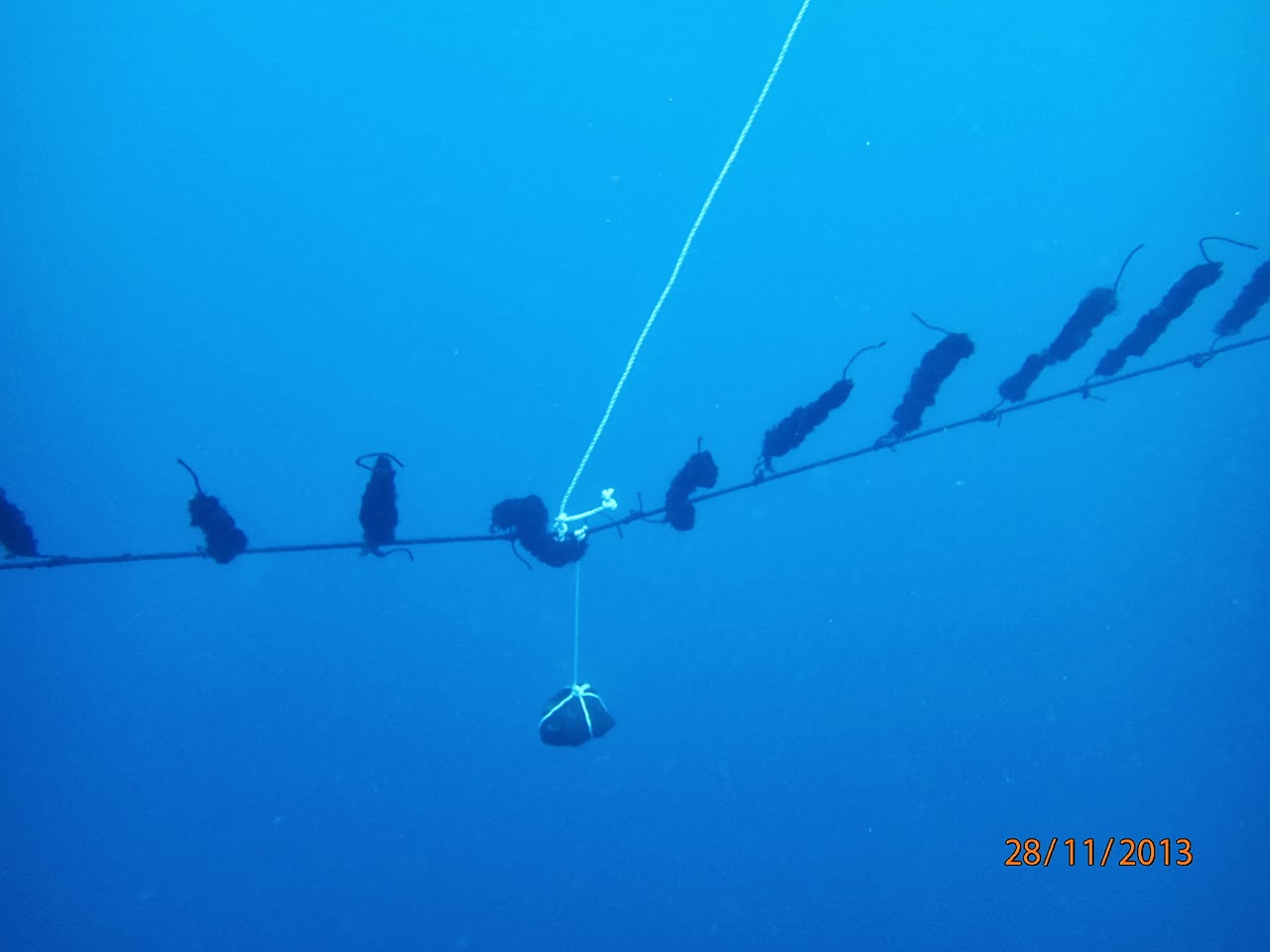
At high tide and in a sudden burst of heavy rain, we headed offshore just a little ways to place the lines. We used flour sacks full of sand as anchors and tied tied large stones to the middle of the line for it to sink. In two weeks time we will cut away the stones, as the line will become heavy. The line rests about 5m below the surface, so passing boats will not disturb it. Four buoys mark each 100m line.

Checking the depth

Tying off the sandbag anchors

Placing the first buoy
Stringing out the first line

Buoys marking the submerged line


Fisheries Team Member and my trusty Environment Committee Members

Line in the water. The spat collectors (black, dangley things) will fall down in time.

Stone weight.

Myself and one of my many Fijian fathers checking out the line underwater
The line will remain in place for about a year, after which the team will return to see how many oysters we were able to collect. A good line can collect anywhere from 2000-4000 oysters. At a year and a few months time the oysters will be seeding size. Then they can be sold to pearl farmers for around $2 per oyster.

There are a few pearl farms in Fiji. The most notable is J. Hunter Pearls in Savusavu who sells gorgeous jewelry no one in Fiji can afford (http://www.fijipearls.com/)

We don't have a proper site to farm the pearls in the village. A farm requires a quiet bay or lagoon, and we have an intertidal reef flat. The good current coming off the Bligh Waters, however, may be filled with oyster spat. Oyster eggs and sperm meet in the water and drift on currents until finding a proper place to call home. Hopefully they will find a good home on our lines!

The lines were placed in the area we have proposed as a Marine Protected Area (awaiting formal approval of the chief). We hope they will give additional incentive to the community to protect these waters and help create a sustainable fund for management of this and other village projects. Furthermore, the lines will act as FADs (fish aggregating devices) around which fish may group or swim.

A great reason to give thanks, indeed!

I am thankful for this and all my experiences here in Fiji, for the wonderful people who help make projects like this happen, and friends and family both near and far.

Thankful today, thankful for every day.


Saturday, November 23, 2013

The Plantation


This weekend was the first day Solo and I went to the plantation together to actually work. I’ve gone with him to pick food, but that’s not really working that’s just getting dinner. 

“Going to the plantation” really means hiking up into the jungled hills behind the village. We followed the old, two-track road part way up through the pine plantation. The first time I saw one of these spindly pine stands in Fiji, I was a little shocked. They take me back to the highland American West and seem out of place in the tropics. A local forester told me that pine is one of the only easy things to replant after a clear cutting. I’ve asked around the village: “What was there before the pine? What was there before the grassy hillsides?” “Only our grandparents knew.” There’s nowhere to go and look it up. But I’ve heard them tell stories of rainbows of birds and read in the history books of how Bua was one of the first places foreigners came to clear the once great stands of sandalwood. 

We veered off on a path sloping down into the valley below. I try to remember to look up every now and again from futilely dodging mud holes to take in the scenery. It’s a beautiful place we live. Solo didn’t spend his life in these hills; he doesn’t know it the way he knows Seaqaqa, but he knows it better than any map could ever explain. Every place has a name, never written down. “There was an old settlement here. This is where so and so used to farm. That big tree is where a spirit lives.”

We made our way down to the valley bottom and followed the creek uphill. Because Solo is starting a new plantation, it doesn’t have a well traveled path from this side. It’s nice walking in the creek anyway. It’s cool and shady.

Solo and I are planning to go to the US next year to visit for the holidays. Although it’s more than a year off, he has to plant now in order to be able to harvest in time. It takes anywhere between 8-12 months to harvest dalo (taro root) depending on the species, weather, etc. There is no bank account from which to withdraw. You plant, you harvest, you sell. That’s where money comes from.

Our relationship flourishes when we each make efforts to understand where the other is coming from. I want to support Solo in what he does and I want him to support me. We come from very different places but our love exists in some mixed up place in the middle that no one can really understand. 

Solo jokes with me and says how he never dreamed he’d be taking a white girl to work on the farm with him. I laugh and tell him he lucked out to get a country girl like me, because there’s plenty of fancy girls out there who don’t like to get dirty. He says that I’m right, and we talk again about how funny it is that the world brought us together.

Another reason I wanted to come and help is because his other plantation was poached. And it’s kind of indirectly my fault. One of his cousins harvested all Solo’s kava plants when we were both away. Some of them were very old. When he sold them we hear he got a few thousand dollars, but we’ll never know the exact amount. Kava grows for at least 3 years before you harvest it. The longer it grows the bigger it gets and the more money you make because it’s sold by the kilo. That was going to be the start of Solo’s money to put towards building a house someday.

A large number of young men in the village are jealous/ angry/who knows what, and it’s no secret that it has something to do with me. Some quietly and some not so quietly disowning or turning against Solo. It breaks my heart, but then again they might not be bad “friends” to lose. Solo’s too much a pacifist to demand justice. He says that when someone takes something from him that it’s very hard for him to ask for it back. In some ways I wish I was more like that, not automatically wanting to seek revenge. In others ways, I wish he’d raise a ruckus. May karma right things in time.

We are each others’ support systems against all the village drama, of which I am no longer immune to. I crossed some superficial sweet spot on the integration scale. It’s good in a way. I guess it makes me able to relate just a little bit more to my colleagues/neighbors/family/friends. (Talk about blurred lines…) 

We are not dwelling on it, but keeping on keeping on!

Each of us armed with a cane knife (machete), we begin our laborious mission of taming the wild. I think of the greed behind “manifest destiny” and those whom tamed the American wilds. I think of the idea of “last frontier”. 

Here, making a small clearing in the forest, we will plant and harvest. We will get our crops, but it will take a fight. It has been cleared before. Solo points to the old yavu, terraced foundations for houses.  It is hard to imagine the land ever being clear as my muscles start to burn from the constant swinging of my machete. It reminds me of swinging an ax. Maybe Solo can read my mind because he asks me to tell a story about the trail work I used to do in America.

We work for two hours. Solo could go all day, but he’s being nice to me. I’m out of shape for manual labor. I have blisters on my hands and a painful bee sting on my face. With the clearing he did the day before, and our work today, he’ll be able to plant 500 dalo. If he’s lucky he can get $1000. Next he’ll have to find dalo tops to plant and then turn the soil by hand.

We’re both drenched in sweat and covered in debris. We grab our empty water bottle and trudge our way back to the creek. It’s at least 20 degrees cooler under the shade of the ancient grove of ivi trees. There is a swimming hole, cold and clean. We jump in and relax on the submerged boulders. I am spent. I am in awe of place and person. 


Tuesday, November 19, 2013

Sea Cucumbers and More Mangroves

Things have been a little slow in the village as we're waiting on the elders to meet with the chief, however, in the meantime we are continuing with our on-going projects.

Two weeks ago we waded around in the foreshore to collect sea cucumbers to put in our marine protected area. We were only able to collect about 30. It was low tide and the sun made the water very hot. The sea cucumbers were buried in the sand and they were hard to find, even by experienced Fijian eyes. Next time maybe we'll snorkel around at high tide when they're out and about.

Collecting sea cucumbers along the foreshore

 
Sea cucumbers are a high value species because the are a delicacy in certain Asian cuisines. A truck comes around every week to buy dried sea cucumbers from local people to take to the market. Some sea cucumbers can grow very large. The larger the sea cucumber the higher the price.

Large sea cucumber from the outer reef (this one caught by a free diver to sell)


Over-harvesting is the current reality -- as sea cucumbers move slowly, they are an easy target and easy money. One can apply for a special license to use SCUBA to harvest them. Fishermen are going farther and deeper to find them as their numbers decline.

We're hoping to learn more about sustainable harvest of sea cucumber species and to breed them in our marine protected area. It has potential to be a good income generator for the village if done the right way.

For more info, check out this cool fact sheet!
 From http://www.spc.int/DigitalLibrary/Doc/FAME/Brochures/Anon_11_ISFC_09_SeaCucumbers.pdf


We also planted about 100 more mangroves from our mangrove nursery. We tried transplanting some 2 ft high seedlings a month ago, but they all died. It was an experiment. The nursery takes longer but it seems the survival rate is decent, although not great. If we plant a few seedlings together they seem to be able to withstand the tide/waves better. However, they are still susceptible to seaweed weighing them down and pigs digging them up at low tide.